The appearance of the Gutenberg Bible in or around 1455 marked a revolutionary milestone in the production of books and the Bible in particular. Despite Gutenberg losing control of his workshop prior to the release of his groundbreaking Bible, in the following years printing spread across Europe and new textual innovations were introduced. The following is a selection of Latin Bibles printed before 1530, each representing key advancements and unique “firsts” within the world of Bible production.
❧First Bible printed with moveable metal type
Biblia Latina, [Mainz, Printer of the 42-line Bible [Johann Gutenberg] and Johann Fust, about 1455]. Royal Folio. Bod-Inc B-237, D&M 6076 https://www.ustc.ac.uk/editions/740039 (no. 1)
❧First to include the names of the printers and the date
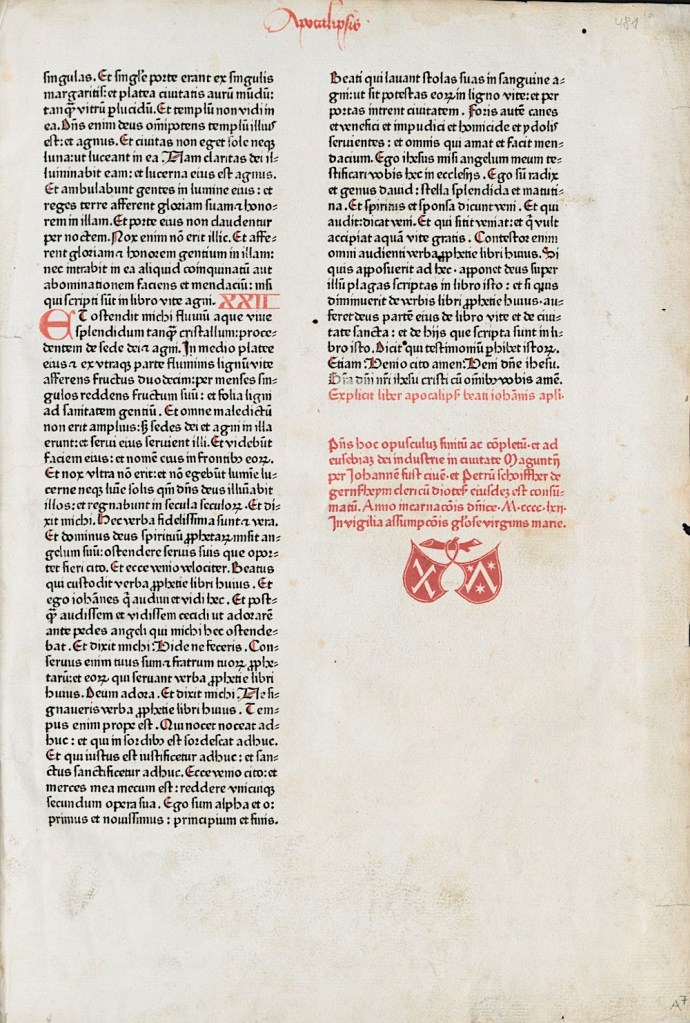
Biblia Latina, Mainz, Johann Fust, and Peter Schoeffer, 14 August 1462. Royal Folio. Bod-Inc B-239, D&M 6080 https://www.ustc.ac.uk/editions/740043 (no. 4)
Colophon, Biblia Latina, Johann Fust and Peter Schoeffer, 1462
❧First to include Interpretationes Hebraicorum nominum ❧First Bible printed in Roman Type
Biblia Latina, edited by Giovanni Andrea Bussi, Rome, Conrad Sweynheym and Arnald Pannartz, [not before] 1471. Roman type. Royal Folio. Bod-Inc B-245, D&M 6081 https://www.ustc.ac.uk/editions/999307 (no. 9)
❧ First to include Eusebius’s Canon Tables ❧First to include marginal references to parallel passages ❧First to include additions by Menardus Monachus
Biblia Latina, with additions by Menardus Monachus, [Basel, Bernhard Richel, not after 1474]. Folio. Bod-Inc B-247, D&M 6081 (“Early Basel Editions”) https://www.ustc.ac.uk/editions/740050 (no. 12)
Eusebian Canon Tables, Biblia Latina, Bernhard Richel, 1474
❧First Latin Bible printed at Venice
Biblia Latina, Venice, Franciscus Renner, and Nicolaus de Frankfordia, 1475. Includes Interpretations of Hebrew Names. Folio. Bod-Inc B-251, D&M 6081 (note 3) https://www.ustc.ac.uk/editions/999306 (no. 14)
Biblia Latina, Paris, Ulrich Gering, Martin Crantz, and Michael Friburger, [1476-1477]. Folio. Bod-Inc B-259, D&M 6081 (note 7) https://www.ustc.ac.uk/editions/202868 (no. 24)
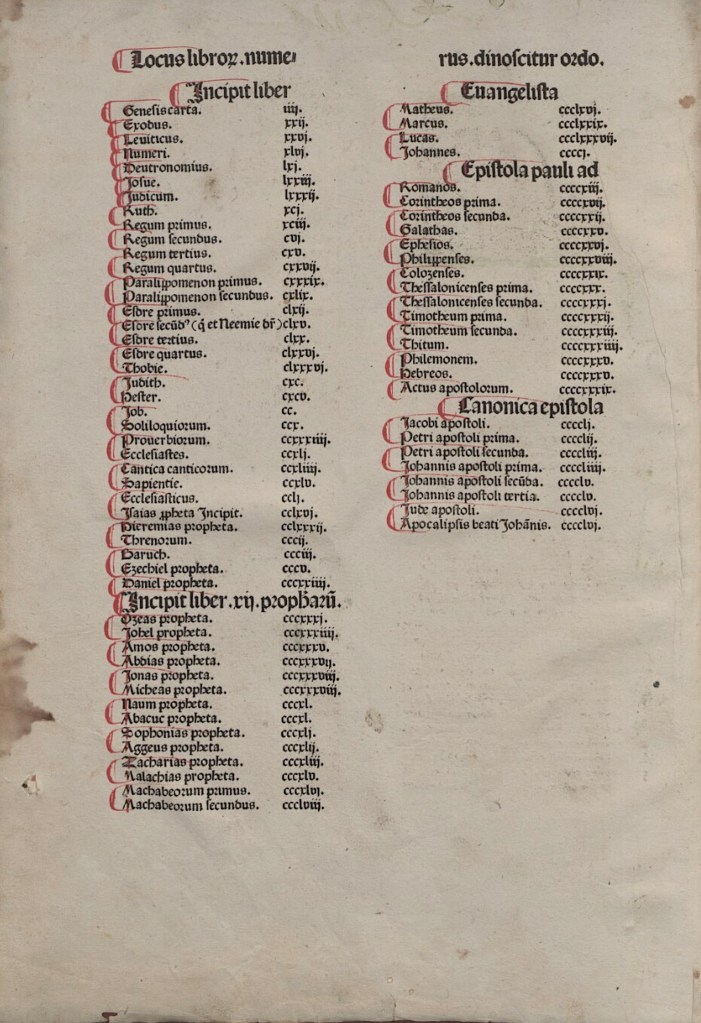
❧First to include a table of contents
Biblia Latina, with additions by Menardus Monarchus, Nuremberg, Anton Koberger, 14 April 1478. Folio. Bod-Inc B-266 https://www.ustc.ac.uk/editions/740062 (no. 34)
Table of contents, Biblia Latina, Anton Koberger, 1478
Biblia Latina with the Glossa Ordinaria of pseudo-Walafrid Strabo and interlinear glosses of Anselmus Laudunensis. [Strasbourg, Adolf Rusch, for Anton Koberger, not after 1480]. Folio. D&M 6083 (note) https://www.ustc.ac.uk/editions/740091 (no. 45)
Biblia Latina cum postillis Nicolai de Lyra et expositionibus Guillelmi Britonis in omnes prologos S. Hieronymi et additionibus Pauli Burgensis replicisque Matthiae Doering [Latin Bible with Commentaries by Nicolas of Lyra and expositions by William Briton on all the prologues of St. Jerome, with additions by Paul of Burgos and replies by Matthias Doering], Venice, [Johannes Herbort], for Johannes de Colonia, Nicolaus Jenson, and associates, 31 July 1481. Folio. https://www.ustc.ac.uk/editions/999283 (no. 49)
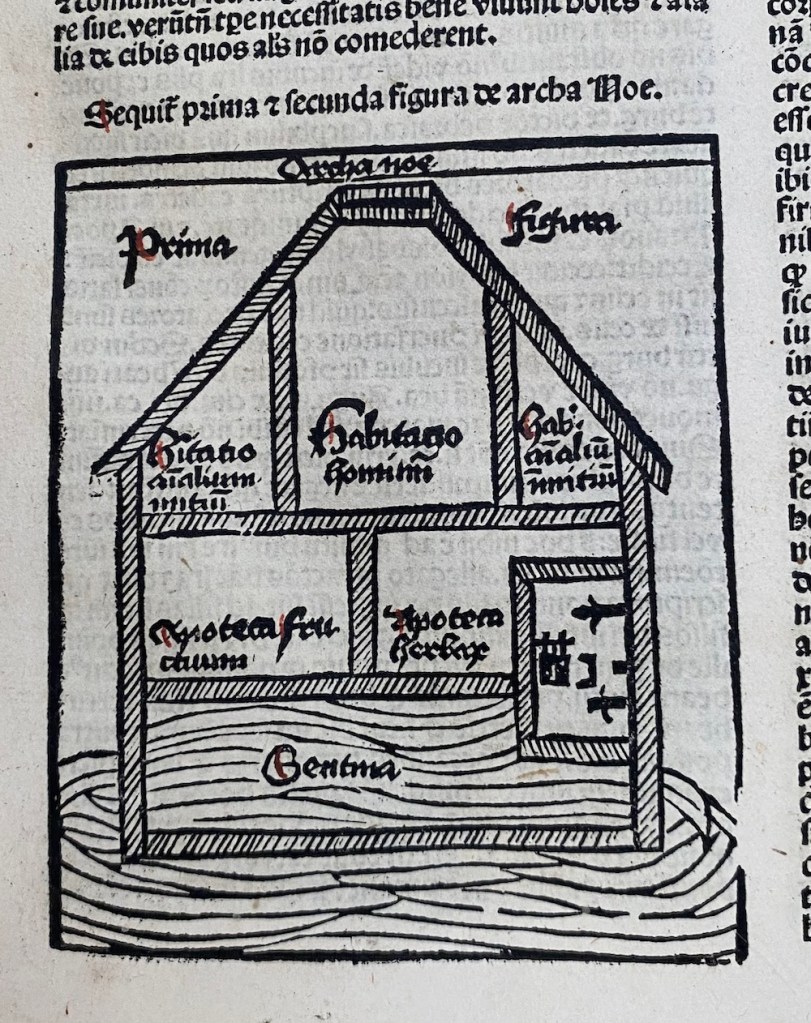
❧First Latin Bible to include woodcut illustrations
Biblia Latina cum postillis Nicolai de Lyra et expositionibus Guillelmi Britonis in omnes prologos S. Hieronymi et additionibus Pauli Burgensis replicisque Matthiae Doering. Nicolaus de Lyra, Contra perfidiam Judaeorum [Latin Bible with Commentaries by Nicolas of Lyra and expositions by William Briton on all the prologues of St. Jerome, with additions by Paul of Burgos and replies by Matthias Doering. Also Nicolas of Lyra’s Against the Treachery of the Jews], Nuremberg, Anton Koberger, 1485. Folio. https://www.ustc.ac.uk/editions/740095 (no. 61)
Detail, Noah’s Ark, Biblia Latin cum Postillis, Anton Koberger, 1485
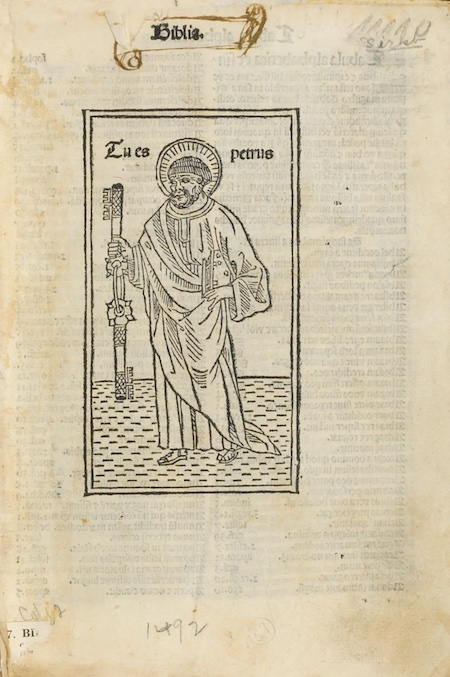
❧First to include a woodcut on the title page ❧First to include Tabula Alphabetica Historiarum Bibliae andTranslatores Biblie
Biblia Latina, Venice, Hieronymus de Paganinis, 7 September 1492. Octavo. Edited by Petrus Angelus de Monte Ulmi. D&M 6087 https://www.ustc.ac.uk/editions/999289 (no. 79)
Title, Biblia, Hieronymus de Paganinis, 1492
❧First to include Tabula super Bibliam per versus composita (attributed to Alexander Villadeus)
Biblia cum tabula nuper impressa & cum sumariis nouiter editis, Venice, Simon Bevilaqua, 8 May 1498. Quarto. D&M 6089 https://www.ustc.ac.uk/editions/999285 (no. 93)
Death of Jacob, Biblia, Simon Bevliqua, 1498
❧First to correct corruptions in Jerome’s Vulgate (edited by Alberto Castellano)
Biblia cum pleno apparatu summariorum concordantiarum et quadruplicis repertorii [Bible with a full apparatus of summaries, concordances, and four indices], [Paris], impressa Thielman Kerver vendunantur & impensis Jean Petit (Paris) & Jean Cabiller (Lyon), 1504. Folio. D&M 6090 (note). https://www.ustc.ac.uk/editions/142918 (no. 100)
❧First to include references to Canon law
Biblia cupleno apparatu summariorum concordantiarum et quadruplici repertorii sive indicii numerique foliorum distinctione basilee nuper impressa [The Bible, with a full apparatus of summaries, concordances, and a four-part index or guide, and numbered pages, recently printed in Basel], [Basel, Joh. Petri, Joh. Froben, 1509]. Folio. D&M 6092 (note) https://www.ustc.ac.uk/editions/616604 (no. 107)
Biblia cum pleno apparatu summariorum concordantiarum et quadruplicis repertorii [The Bible with a full apparatus of summaries, concordances, and a four-part index], Lyon, Jacques Mareschal [et] Simon Vincent, 1510. Octavo. https://www.ustc.ac.uk/editions/143552 (no. 108)
❧First printed in red and black throughout
Biblia cum concordantiis Veteris et Novi Testamenti et sacrorum canonum necnon et additione in marginibus varietatis diversorum textuum ac etiam canonibus antiquis quattuor evangeliorum insertis summa cum diligentia revisa [The Bible, accompanied by concordances of the Old and New Testaments and the Sacred Canons, with marginal additions highlighting textual varieties. It includes the Ancient Canons of the Four Gospels, all diligently revised], Lyon, Nicolas de Benedictis vendunantur Etienne Guenard, 1512. Quarto. https://www.ustc.ac.uk/editions/143900 (no. 117)
❧First edition with numbered verses First new translation from the original languages
Biblia. Habes in hoc libro prudens lector utriusque instrumenti novam tranlationem [sic] aeditam necnon et librum de interpretamentis Hebraicorum, Aramaeorum, Graecorumque nominum, sacris in literis contentorum [Bible. In this book, discerning reader, you will find a new edition of the translation of both the Old and New Testaments, along with a book on the interpretations of Hebrew, Aramaic, and Greek names found within the Sacred Scriptures], Lyon, Antoine du Ry impensis François Turchi [et] Dominici Berticinium et Jacques Giunta, 1528. Quarto. D&M 6108. https://www.ustc.ac.uk/editions/145898 (no. 167)
❧First attempt at a critical edition
Biblia et Hebraica, Chaldaea, Graecaque et Latina nomina virorum, mulierum, populorum quae in Bibliis sparsa sunt hoc volumine comprehenduntur cum interpretatione Latina [The Bible, and the Hebrew, Chaldean, Greek, and Latin names of men, women, and peoples that are found scattered throughout the Bible, are all contained in this volume, complete with Latin interpretations], Paris, ex officina Robert Estienne, 1528. Folio. D&M 6109 https://www.ustc.ac.uk/editions/181095 (no. 169)
❧Innovation and the Production of Latin Bibles, c1455-1529
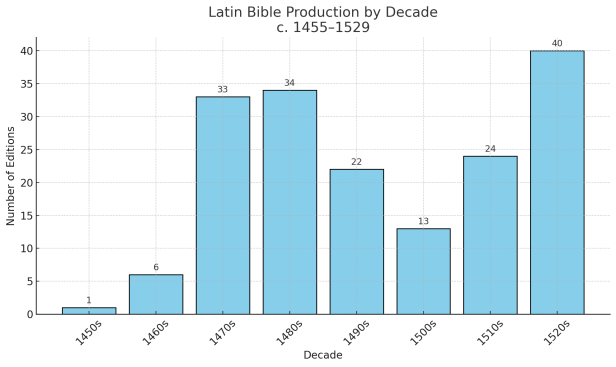
The period from 1455 to 1530 was a transformative era for the printing of Latin bibles, characterised by a multitude of ‘firsts’ intertwined with wider historical, political, and religious events in Europe. The first Bible printed with movable metal type, Gutenberg’s famous Biblia Latina (c1455), revolutionised the production of books against a backdrop of steadily rising literacy rates, the growth of universities, and expanding religious debate — all of which escalated the demand for books. Amidst the continuing spread of humanism throughout the Renaissance, the wider dissemination of the Bible played a central role in catalysing religious, cultural, and intellectual movements across Europe.
In 1462, Johann Fust and Peter Schoeffer, Gutenberg’s early collaborators, became the first to include their names and the date of printing in a Latin Bible. This development marked a crucial shift towards the recognition of individual contributions in book production, mirroring a growing emphasis on individualism seen in Renaissance humanism. Such developments were occurring, moreover, at a time when the art of printing was becoming entrenched across Europe, thereby accentuating the growing importance of a small concentration of urban printing hubs in Italy, France, and Germany in the production, dissemination, and interpretation of the Bible in Latin.
In the following decades, as a growing number of printing houses began publishing rival editions of the Latin Bible, additional reference, paratextual, and interpretive apparatus began to appear before, after, and alongside the biblical text. The inclusion of the Interpretationes Hebraicorum nominum (a glossary or list of Hebrew names found in the Bible, along with their Latin translations or interpretations, attributed to St Jerome) in 1471, and Eusebius’s Canon Tables (a cross-referencing system created to harmonise the four Gospels, see below) in 1474, helped not only to distinguish one Latin Bible from another, but also reflected a sharply rising interest in textual criticism and comparative study. At the same time, the appearance of new biblical prefaces such as Modi Intelligendi Sacram Scripturam (1487) and Ad divinarum litterarum … amatores exhortatio (1491), helped people who had not been trained to read the Bible in a monastery, seminary, or university, to understand the ancient exegetical traditions of the Church and to appreciate how reading the Bible could improve their own spiritual wellbeing.
Eusebius’s Canon Tables, Biblia cum concordantiis Veteris et Novi Testamenti & sacrorum canonum, Venice, Lucantonio Giunta, 1511. Private Collection. Photographed by Scott McLaren.
The appearance of the first Latin Bible in 1480 printed with ‘glosses’ (notes or explanations intended to provide definitions, translations of difficult words, theological interpretations, or additional context), can be seen as part of the period’s wider trend to make the biblical text more accessible – as well as, perhaps ironically, an effort to narrow interpretive possibilities in a restive cultural context. In a similar way, the first inclusion of references to Canon Law in a Latin Bible printed in 1509 — an apparatus soon incorporated by other printers — served as a practical way to reinforce more traditional readings of the Bible in line with Catholic orthodoxy. Concurrently, and to some extent exerting force in the opposite direction, we witness the appearance of new editions of the Bible — notably the Latin Bible printed in Basel by Johann Amerbach in 1479 — that were consciously attentive to Greek and Hebrew sources. Referred to as the ‘Fontibus ex Graecis’ editions, these bibles embodied the Renaissance interest in improving texts by returning to the original sources. This was followed by progressively more sophisticated renderings, such as those based on Alberto Castellano’s revised text first published in 1504, ultimately culminating in the 1528 publication of an entirely new translation of the Bible into Latin that refused altogether to privilege Jerome’s Biblia Vulgata.
By the time the first Latin Bible printed with woodcut illustrations appeared in 1485, and the first Latin Bible with narrative illustrations in 1498, Europe was in the midst of a remarkable blossoming of visual arts. This development was not merely aesthetic. It also represented an important shift in religious pedagogy and literacy that was occurring during the late Middle Ages and early Renaissance in Europe. These visual aids played an important role in religious instruction, allowing the laity to gain a deeper understanding of biblical narratives and religious doctrines by fostering a deeper engagement with the text. Woodcut illustrations also made each Bible an object of art in its own right, enhancing its status and desirability. Simultaneously, the transition to smaller formats such as quartos, octavos, and sextodecimos made the Bible more more affordable and therefore more accessible to a broader audience. Such Bibles could be owned and read by individuals interested in fostering a more personal form of piety less reliant on institutional intermediaries. As these less expensive Latin bibles proliferated, they both encouraged more traditional forms of piety, and led to the emergence of reformist ideas throughout Europe.





 Bibliographia Bibliorum Latinorum