
One of the more curious developments in the history of the printed Bible occurred during the final decade of the fifteenth century. Within the space of six years, two printers working independently on opposite sides of the Alps produced remarkably similar books: compact octavo Latin Bibles designed for the individual reader. Johann Froben in Basel issued editions in 1491 and 1495; Hieronymus de Paganinus in Venice followed with editions in 1492 and 1497. Their resemblance is too striking to dismiss as coincidence, yet no evidence suggests direct collaboration. The explanation lies instead in a shared set of historical circumstances. Both printers recognised that one of the most successful inventions of medieval manuscript culture—the portable Paris Bible—answered a need that had once again become pressing in the age of print.
❧ A Medieval Inheritance: The Paris Bible
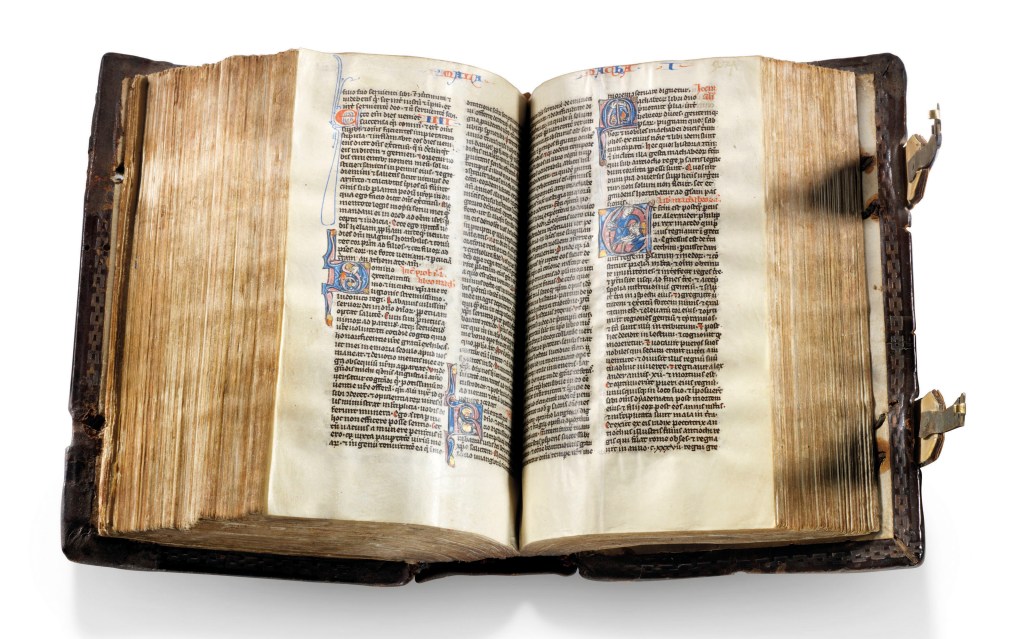
The origins of these printed octavos do not lie in the printing houses of Basel or Venice, but in the workshops of thirteenth-century Paris. Around the 1220s and 1230s, in response to the rapid expansion of the University of Paris and the preaching orders, scribes and stationers developed a new kind of Bible unlike anything that had previously existed. Instead of the large, imposing pandects that had dominated earlier centuries, these manuscripts compressed the entire Vulgate into a single, remarkably portable volume. Their achievement was also one of organisation. The biblical books were arranged in a standard order, the text was divided according to the chapter system popularised by Stephen Langton, and a variety of navigational aids made the Scriptures increasingly accessible to readers who needed to locate passages quickly for preaching, teaching, and study. These Paris Bibles rapidly became the standard form of the Latin Bible throughout western Europe, copied in their thousands and carried by Dominican and Franciscan friars, university masters, students, bishops, and increasingly by prosperous members of the laity. Their success rested upon a simple but enduring insight: the Bible was most useful when it could accompany its reader. By the fifteenth century, however, the great age of the manuscript Paris Bible had long passed. Although existing copies continued to circulate and were often cherished possessions, relatively few new examples were being produced, and the surviving manuscripts remained expensive commodities. At precisely the moment when literacy was expanding, universities were flourishing, and devotional reading was becoming more deeply embedded in religious life, the supply of complete portable Latin bibles no longer kept pace with demand. The problem facing printers in the 1490s, therefore, was not how to invent a new kind of Bible, but how to reproduce, more efficiently and more economically, one of the medieval world’s most successful bibliographical achievements. Froben and Paganinus would answer that challenge by translating the Paris Bible’s essential virtues into the new medium of print.
❧ Why the 1490s?
The appearance of these portable printed Bibles in the 1490s raises an obvious question: why then? Movable type had been introduced to Europe some forty years earlier, and by the close of the fifteenth century printers had already issued hundreds of editions of the Latin Bible, most of them substantial folios intended for churches, monasteries, universities, and wealthy patrons. If the advantages of a compact Bible seem self-evident in retrospect, why had no printer attempted to reproduce the Paris Bible in octavo during the first decades of printing? The answer lies in the convergence of several developments that reached maturity only toward the end of the century. Printers had become increasingly adept at producing dense but legible typography, allowing the complete biblical text to be compressed into a surprisingly small volume without sacrificing readability. At the same time, the economics of printing had begun to favour larger and more diverse markets. Rather than relying solely upon institutional commissions, printers increasingly sought to serve individual purchasers: parish clergy, university students, friars, lawyers, physicians, and educated laypeople who wished to own substantial books for themselves. A portable Bible, once a specialised manuscript associated with the universities of medieval Paris, now promised to become a commercially viable printed commodity.
This changing market reflected broader transformations in European intellectual and religious life. Universities continued to expand, creating communities of readers for whom books were daily tools. Northern humanism encouraged close engagement with authoritative texts and fostered habits of careful reading that extended well beyond classical literature. Movements such as the devotio moderna promoted a more personal and meditative spirituality centred upon the imitation of Christ and the regular reading of Scripture. Even in Italy, where Renaissance culture often expressed itself through civic life, art, and classical learning, printers encountered an increasingly sophisticated readership that valued books as instruments of study as well as objects of prestige. These developments did not create a demand for the Bible—they transformed the conditions under which that demand could be met. By the 1490s, the medieval ideal of a complete, portable, navigable Bible no longer belonged solely to the manuscript age. The technology of print had finally advanced to the point where it could realise that ideal on a scale unimaginable to the professional scribes of thirteenth-century Paris. Froben and Paganinus recognised this opportunity independently, each producing books that looked backwards to the medieval university while addressing the needs of a rapidly changing Europe.
❧ A Tale of Two Cities
If the four octavo bibles answered a common European need, they nevertheless emerged from two cities whose identities could scarcely have been more different. Basel and Venice ranked among the great centres of printing by the closing years of the fifteenth century, yet each occupied a distinctive place within the intellectual geography of Renaissance Europe. Basel was a comparatively small imperial city whose importance rested upon its university, its strategic position along the Rhine, and its growing community of scholars, theologians, and printers. Venice, by contrast, was one of Europe’s largest and wealthiest republics: a maritime empire whose prosperity was built upon commerce stretching from northern Europe to the eastern Mediterranean. Books flowed through both cities in extraordinary numbers, but they did so within very different cultural ecosystems.
Basel’s printing industry developed in close conversation with the university and the world of learned scholarship. The city’s presses supplied theologians, canonists, and students, while its workshops increasingly attracted the humanists who were reshaping northern intellectual life. Humanism in Basel was characterised by philology, textual criticism, and the recovery of authoritative texts in their most accurate forms. Evolving spiritual practices further reinforced habits of disciplined reading and private devotion, encouraging an approach to Scripture that was at once scholarly and deeply personal. Within this milieu, a compact Latin Bible aptly reflected an emerging ideal of learned piety in which Scripture accompanied the reader beyond the lecture hall and the choir.
Venice presented a different, though no less fertile, environment. The republic was the unrivalled capital of European printing, producing an astonishing range of books for markets that extended across the continent. Its presses served universities, monasteries, religious orders, civic officials, merchants, and private collectors alike. Competition among printers was intense, fostering continual experimentation in format, typography, and marketing. The city’s intellectual life was equally cosmopolitan. Greek émigré scholars, Italian humanists, Franciscan and Dominican theologians, diplomats, physicians, lawyers, and merchants all contributed to a remarkably diverse reading public. Whereas Basel’s book trade revolved around a relatively concentrated scholarly community, Venice functioned as an international marketplace in which books were manufactured for readers whose interests and professions varied enormously. A successful edition therefore had to combine practical utility with commercial appeal.
These differing environments shaped the character of Froben’s and Paganinus’s respective enterprises without obscuring their common purpose. Froben’s octavos emerged from a world in which books increasingly served scholarship and personal religious study; Paganinus’s from one in which books circulated as commodities through one of Europe’s busiest commercial networks. One city’s defining institution was its university, the other’s its marketplace. Yet neither setting diminished the value of a portable Bible. On the contrary, each demonstrated, in its own way, that the medieval conception of the Paris Bible still answered the needs of late fifteenth-century readers. Basel supplied the intellectual conditions, Venice the commercial ones, but both recognised that Scripture was becoming a book to be carried, consulted, and read with increasing frequency by individuals rather than solely within institutional settings.
❧ Johann Froben
Among the printers who recognised the possibilities of the portable Latin Bible, Johann Froben occupies a distinctive place. Although later generations would remember him chiefly as the printer of Erasmus and one of the great scholarly publishers of the sixteenth century, his career in the 1490s reveals a figure already committed to producing books that combined textual authority with practical utility. Born in Hammelburg in Franconia, Froben almost certainly received part of his training in the workshop of Anton Koberger at Nuremberg, then the largest and most sophisticated printing establishment in Europe. Whether or not every detail of that apprenticeship can be reconstructed, the influence of Koberger’s enterprise is unmistakable. Froben entered the trade with an appreciation for ambitious publishing projects, careful typography, and the commercial realities of the European book market. After settling in Basel, he formed a close partnership with Johann Amerbach, whose workshop was renowned for its theological publications and high editorial standards. Within this learned environment, Froben developed a conception of printing that extended beyond the mechanical reproduction of texts. He was already becoming a publisher in the fullest sense of the word: selecting works, cultivating editors, and shaping books for particular communities of readers.
His octavo Bible of 1491 reflects these priorities with remarkable clarity. Rather than producing a luxurious object for display, Froben created a book intended to be used. Its compact format made it genuinely portable, while its clear typography and carefully organised apparatus facilitated rapid consultation of the biblical text. Chapter divisions, summaries, and indices transformed the volume into a practical instrument for study rather than merely a repository of Scripture. In this respect, Froben was responding to new technological possibilities as well as changing habits of reading. Theological learning increasingly depended upon the ability to move efficiently through authoritative texts, comparing passages, preparing lectures, composing sermons, and conducting private study. The Bible was no longer encountered only through continuous reading or public liturgical proclamation; it had become a book to be consulted, searched, and revisited. Froben’s octavo anticipated these habits with striking intelligence.

His decision to issue a second octavo Bible in 1495 further suggests that the first had found a receptive audience. Although the two editions differ in various bibliographical details, together they demonstrate that the portable Bible was moving beyond experiment to becoming an established part of his publishing programme. They also foreshadow the direction his career would later take. During the opening decades of the sixteenth century, Froben would become Europe’s pre-eminent scholarly printer, collaborating with figures such as Erasmus, Beatus Rhenanus, and Johannes Reuchlin in the publication of editions that transformed biblical and classical scholarship. The celebrated Novum Instrumentum of 1516 did not emerge from nowhere. It was the culmination of a philosophy of printing already evident in the modest octavo Bibles of the previous generation—a conviction that the careful presentation of authoritative texts could reshape the intellectual and religious life of Europe.
Seen in this light, Froben’s octavos occupy an important place within the broader history of northern humanism. They reveal a printer who understood that the physical form of a book could influence the way it was read and used. His achievement lay in presenting the biblical text in a form that made it more readily available to a growing community of scholars, clergy, and educated readers. By thus adapting the medieval Paris Bible to the possibilities of print, Froben preserved one of the most successful formats of the manuscript tradition while quietly preparing the ground for the new scholarship that would define the sixteenth century. Rather than standing at the threshold of the Reformation, his octavo Bibles stand as part of a long northern tradition in which learning, textual fidelity, and practical utility were understood to belong together.
❧ Hieronymus de Paganinus
If Froben’s octavo Bibles emerged from the scholarly milieu of Basel, those of Hieronymus de Paganinus belonged to the vibrant commercial and religious culture of Venice. By the 1490s the republic had become the undisputed capital of European printing, producing more books than any other city on the continent. Printers operated within an intensely competitive marketplace, where success depended upon technical skill as well as identifying new audiences and adapting familiar texts to changing patterns of demand. Venetian presses issued an astonishing variety of works—classical authors, legal texts, liturgical books, devotional manuals, medical treatises, vernacular literature, and works of practical instruction—destined for distribution across Italy, Germany, France, Spain, and beyond. In such an environment, innovation often consisted less in inventing entirely new books than in presenting established texts in forms that appealed to a widening readership. Paganinus’s octavo Bibles exemplify this commercial instinct.
Compared with Froben, Hieronymus de Paganinus remains an elusive figure. The documentary record reveals little of his personal life or intellectual associations, and he never acquired the international scholarly reputation that later surrounded the Basel printer. Yet his surviving publications reveal a capable and perceptive publisher whose programme was carefully attuned to the needs of educated readers. Alongside his editions of the Latin Bible appeared works of canon and civil law, Gregory the Great, the Breviarium Romanum, and other ecclesiastical texts intended for clergy and the learned professions. At the same time, vernacular devotional works demonstrate that his ambitions extended byeond to university scholars or religious specialists. Like many successful Venetian printers, Paganinus appears to have recognised that the boundaries between clerical, scholarly, and lay readership were becoming increasingly fluid.
His first octavo Bible, published in 1492, illustrates this breadth of vision. Although physically comparable to Froben’s editions, it presents Scripture within a richer editorial framework. The edition was prepared by Petrus Angelus de Monte Ulmi, whose editorial supervision lent scholarly authority to the text, while supplementary material broadened its usefulness. Most notable was the inclusion of Gabriel Bruno’s Tabula Alphabetica Historiarum Bibliae, an alphabetical guide to the narratives of Scripture that enabled readers to locate biblical episodes quickly and efficiently. Together with the Translatores Biblie and other prefatory materials, these features transformed the volume into more than a simple biblical text. They offered readers an increasingly sophisticated apparatus for navigating Scripture, reflecting the growing expectation that books should facilitate study as well as preserve knowledge. Such editorial additions reveal a printer attentive to the physical portability of the Bible as well as its intellectual accessibility.

The Venetian edition also speaks to the religious culture from which it emerged. Both Petrus Angelus and Gabriel Bruno were associated with the Observant Franciscan movement, whose commitment to preaching, pastoral care, and scriptural learning helped shape late fifteenth-century devotional life. While it would be misleading to describe Paganinus’s Bible as a specifically Franciscan publication, these connections suggest that it was produced within an intellectual environment deeply concerned with making Scripture more usable for those engaged in teaching and preaching. The edition’s navigational aids would have served friars preparing sermons no less effectively than students consulting biblical passages or lay readers pursuing private devotion. In this sense, the Venetian Bible embodied a conception of readership that was expansive rather than exclusive. It assumed that the Bible belonged not only in libraries and choir stalls but also in the hands of individuals who wished to consult it regularly.
Perhaps the most remarkable testimony to the edition’s influence survives in a single annotated copy. Girolamo Savonarola, the Dominican reformer whose preaching convulsed Florence during the final years of the fifteenth century, owned a copy of Paganinus’s 1492 Bible, now preserved in the Library of Congress. Its margins are filled with his notes, particularly in the Book of Revelation, offering rare evidence of how one contemporary reader actively engaged with the text. The annotations remind us that these octavo bibles were not merely admired as objects of craftsmanship; they were working books, carried, consulted, annotated, and integrated into the intellectual and spiritual lives of their owners. If Froben’s editions foreshadow the scholarly world of Erasmus, Paganinus’s surviving copy evokes a different but equally revealing world—that of the preacher, reformer, and devotional reader who found in the portable Bible an indispensable companion. Together, the Venetian editions demonstrate that the commercial sophistication of the Venetian press could coexist with serious pastoral and scholarly ambitions, producing books whose success rested upon their ability to serve a remarkably diverse community of readers.
❧ Recapturing the Spirit of the Paris Bible
The remarkable similarity of Froben’s and Paganinus’s octavo Bibles is best understood as neither a coincidence nor a case of direct influence, but more probably as the independent rediscovery of an older solution to a perennial problem. Histories of printing often privilege novelty: new technologies, new typefaces, new markets, and new intellectual movements. Yet the success of these four editions reminds us that some of the most significant innovations of the early printed book lay in recognising the enduring value of medieval precedents. Froben and Paganinus did not invent the portable Latin Bible. That achievement belonged to the stationers, scribes, and scholars of thirteenth-century Paris, whose compact pandects had transformed biblical study for generations of university masters and mendicant friars. What the printers of the 1490s accomplished was something different. They recognised that the essential strengths of the Paris Bible—its portability, completeness, navigability, and practicality—remained as compelling in the age of print as they had been in the age of parchment.
In this sense, the octavo Bible represents an important corrective to familiar narratives of the printing revolution. Too often the history of print is told as a story of rupture, in which medieval book culture gave way to something fundamentally new. The octavo Bibles of Froben and Paganinus instead reveal a striking continuity across that technological divide. Printing undoubtedly transformed the economics of book production, dramatically increasing the availability of texts and reducing their cost. But the conceptual model underlying these editions was unmistakably medieval. Their organisation, their physical proportions, and even their assumptions about how Scripture ought to be used all owed a profound debt to the Paris Bible tradition. Far from abandoning medieval bibliographical culture, they preserved and extended one of its greatest achievements.
Their appearance also illustrates how innovation in the history of the book often occurs through adaptation rather than invention. The true novelty of these editions has little to do with editorial intervensions to the biblical text, which remained the familiar Vulgate, but rather in their successful translation of a manuscript format into the new medium of print. Advances in typography made it possible to compress the entire Scriptures into an octavo volume without sacrificing legibility, while the economics of printing enabled hundreds of readers to acquire books that would previously have required months of scribal labour. What had once been a specialised manuscript associated with the universities of medieval Paris became, through print, a practical and affordable possession for clergy, students, scholars, and increasingly for educated laypeople across Europe.
The subsequent history of these editions demonstrates the breadth of the readership they served. Savonarola’s heavily annotated copy of Paganinus’s 1492 Bible offers rare evidence of one influential reader engaging intensely with the text, particularly in the prophetic books that shaped his preaching. Froben’s octavos cannot yet be associated with such a celebrated owner, but their wider intellectual context is equally suggestive. Within little more than a generation, Froben himself would become the principal printer of Erasmus, whose editions of the New Testament transformed biblical scholarship and helped reshape the intellectual landscape of Europe. Between Savonarola in Florence and Erasmus in Basel stretched a broad community of readers: university masters preparing lectures, friars composing sermons, parish clergy studying Scripture, and students learning the habits of theological enquiry. These octavo Bibles neither anticipated the Reformation in any straightforward sense nor belonged exclusively to the world of Renaissance humanism. Rather, they equipped the generation that would experience both.
Seen in this light, the portable Latin Bible occupies a more significant place in the history of the printed book than it has often been accorded. It was not simply another edition of the Vulgate, nor just one commercial success among many others. It represented the maturation of an idea first realised in the workshops of thirteenth-century Paris: that the Bible was most useful when it could accompany its reader. Froben and Paganinus recognised that this insight had lost none of its force. Their achievement was to carry it across one of the great technological revolutions of European history, preserving the functional genius of the medieval Paris Bible while making it available to an unprecedented number of readers.
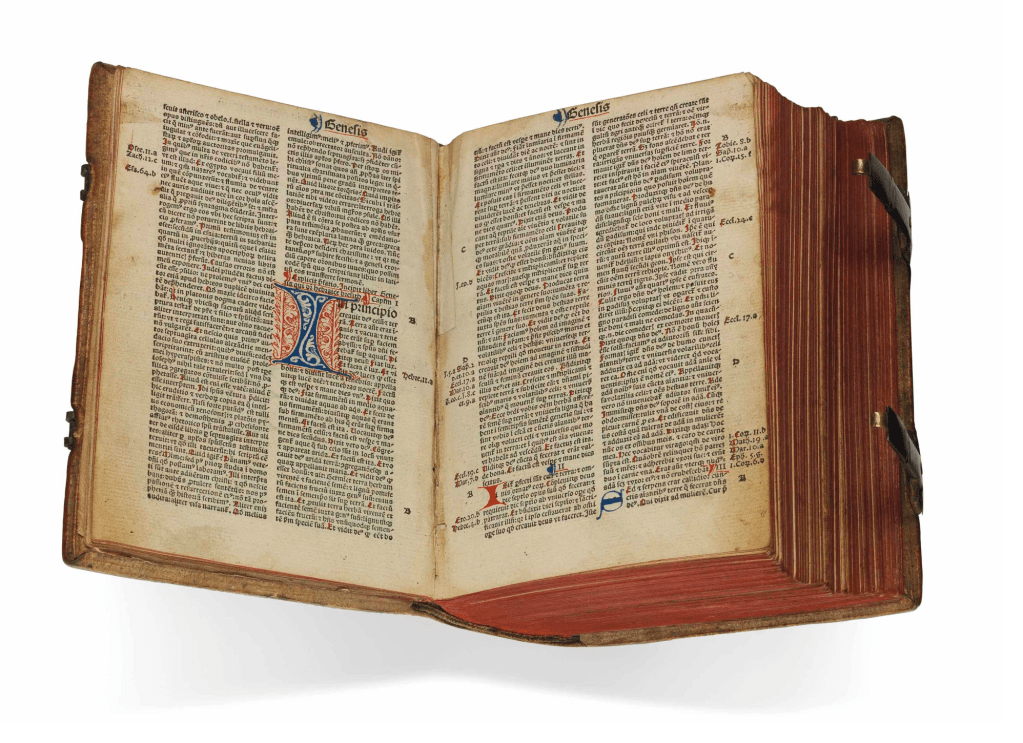
The story of these four octavo editions therefore challenges us to rethink the relationship between manuscript and print. Rather than standing on opposite sides of a historical divide, they reveal a profound continuity between the two media. The printing press did more than simply replace the manuscript: it often perfected its most successful forms. In the hands of Froben and Paganinus, one of the finest achievements of medieval bibliographical culture found new life in print. These compact volumes looked back to the High Middle Ages even as they prepared readers for the intellectual and religious transformations of the sixteenth century. Their enduring significance lies precisely in that paradox: among the most modern books of the 1490s were those that most faithfully embodied a medieval solution to the enduring challenge of placing the whole of Scripture into the hands of a single reader.

