
❧ Introduction
Hieronymus de Paganinis’s Latin Bible, completed at Venice on 7 September 1492, was an unusually ambitious undertaking. Printed in octavo, it was only the second complete Latin Bible to appear in this remarkably compact format and the first of just two Bibles produced by Hieronymus de Paganinis, the second following in 1497.
Its colophon is unusually expansive. Rather than merely recording the circumstances of production, it presents the Bible as a Liber vitae — a “Book of Life” — and describes both its textual apparatus and its manufacture. The colophon notes its marginal concordances, interpretations of Hebrew names, and alphabetical table, credits the Franciscan scholar Petrus Angelus de Monte Ulmi with correcting and emending the text, and finally identifies the volume as printed at his own expense and by his own craft (sumptibus et arte Hieronymi de Paganinis). What follows is a transcription and translation of this remarkable statement of the printer’s conception of his book.
❧ Colophon
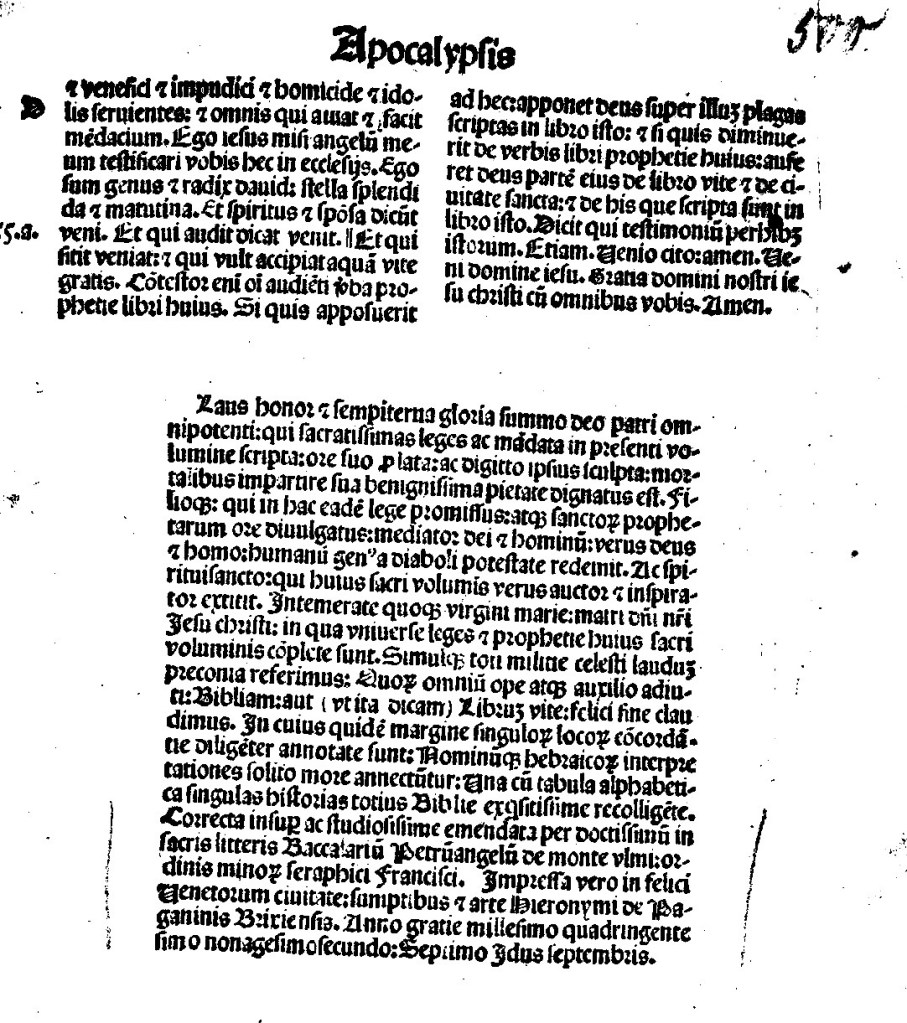
❧ Latin Transcription
Laus, honor et sempiterna gloria summo Deo Patri omnipotenti: qui sacratissimas leges ac mandata in presenti volumine scripta: ore suo perlata et digito ipsius scripta: mortalibus impartire sua benignissima pietate dignatus est. Filiusque: qui in hac eadem lege promittisse atque sanctorum prophetarum ore divulgatus: mediator Dei et hominum: verus Deus et homo: humanum genus a diaboli potestate redemit. Ac Spiritu Sancto: qui huius sacri voluminis verus auctor et inspirator extitit. Intemerate quoque Virgini Mariae: matris Domini nostri Iesu Christi: in qua universae leges et prophetiae huius sacri voluminis completae sunt. Summisque toti militiae caelesti laudum praeconia referimus. Quorum omnium ope atque auxilio adiutricem. Bibliam: aut (ut ita dicam) Librum vitae: felici sine claudimus. In cuius quidem margine singulorum locorum concordantiae diligenter annotatae sunt. Nominumque hebraicorum interpretationes solito more annectuntur. Una cum tabula alphabetica singulas historias totius Bibliae exquisitissime recolligente. Correcta insuper ac studiosissime emendata per doctissimum in sacris litteris Baccalaureum Petrum Angelum de Monte Ulmi ordinis Minorum Seraphici Francisci. Impressa vero in felici Venetorum civitate: sumptibus et arte Hieronymi de Paganinis Brixiensis. Anno gratiae millesimo quadringentesimo nonagesimo secundo: septimo Idus Septembris.
❧ English Translation
Praise, honour, and everlasting glory be to the most high God, the Almighty Father, who in his most gracious goodness deigned to impart to mortals the most sacred laws and commandments written in the present volume, proclaimed by his own mouth and written by his own finger; and to the Son, who, promised in this same law and proclaimed by the mouth of the holy prophets, the mediator between God and mankind, true God and man, redeemed the human race from the power of the devil; and to the Holy Spirit, who was the true author and inspirer of this sacred volume. We also offer proclamations of praise to the undefiled Virgin Mary, mother of our Lord Jesus Christ, in whom all the laws and prophecies of this sacred volume were fulfilled, and to all the highest host of heaven. With the aid and assistance of all these, we bring the Bible—or, so to speak, the Book of Life—to a happy conclusion. In its margins, cross-references to corresponding passages have been carefully noted. Interpretations of Hebrew names are appended in the customary manner, together with an alphabetical table most diligently gathering together the individual histories of the whole Bible. It was moreover corrected and most carefully emended by Petrus Angelus de Monte Ulmi, Bachelor learned in Sacred Letters, of the Order of Minors of the Seraphic Francis. It was printed in the fortunate city of Venice, at the expense and by the craft of Hieronymus de Paganinis of Brescia, in the year of grace 1492, on the seventh day before the Ides of September.
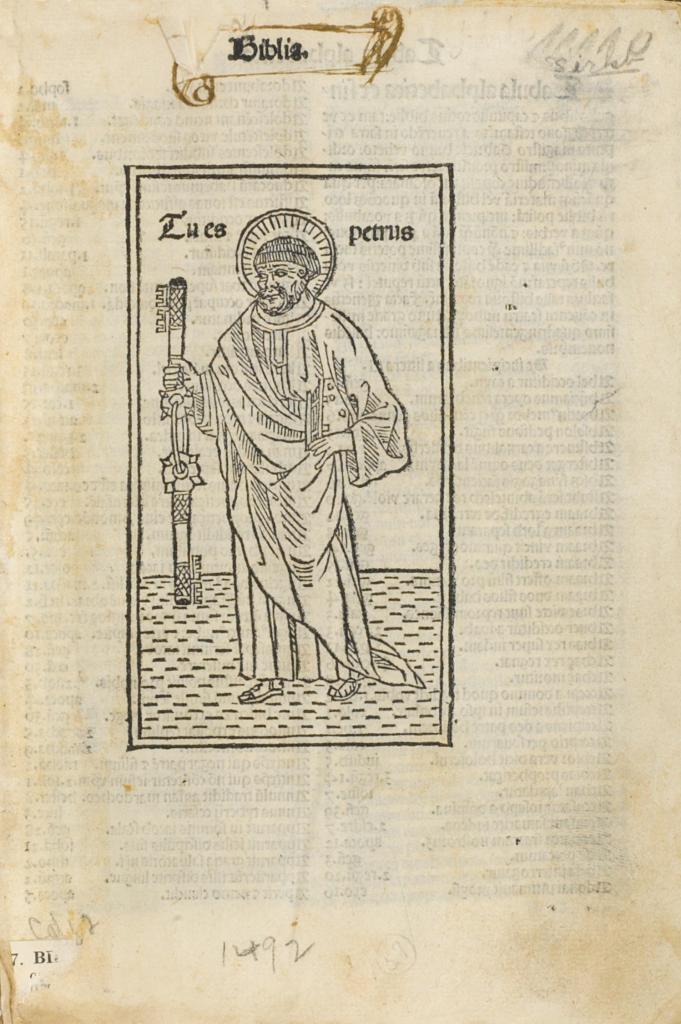
❧ Tu es Petrus – “You are Peter”
(cf. Matt. 16:18)
 Bibliographia Bibliorum Latinorum