
❧ Introduction
Renaissance humanism placed an immense value on returning to original sources, or ad fontes. This impulse found an early expression in a folio Latin Bible printed by Nicolaus Kesler in 1487. Here for the first time we find a short but groundbreaking preface titled Translatores biblie. With remarkable economy, this preface sets out a history of biblical translation beginning with the Greek Septuagint in ancient Alexandria, proceeding through successive Latin renderings, and culminating in the monumental and ubiquitous translation of St. Jerome. It was soon taken up by other printers across Europe, most notably by Johann Froben and Hieronymus de Paganinis in their new octavo Latin Bibles printed in the early to mid-1490s. Its wide diffusion meant that its influence was never tied to a single printer or even a single editor, but rather to a developing editorial culture. Yet it was likely not wholly uncontroversial. While it clearly spoke to the humanist desire for authentic knowledge and accurate texts, it also complicated that desire by underscoring the inescapably imperfect state of any particular edition of the Bible. At the same time, by placing St Jerome and his translation within a wider historical sequence of continual emendation, the aura of singular inspiration that clung to the saint and his work was, if not diminished, at least reframed. A careful reader could not help coming away with a clearer sense that the Bible, though a sacred and inspired text, nevertheless possessed its own long editorial history—a history extending back well before the invention of printing, yet newly visible within it.
❧ Anonymous text as it appears
in Jacques Sacon’s 1509 Biblia
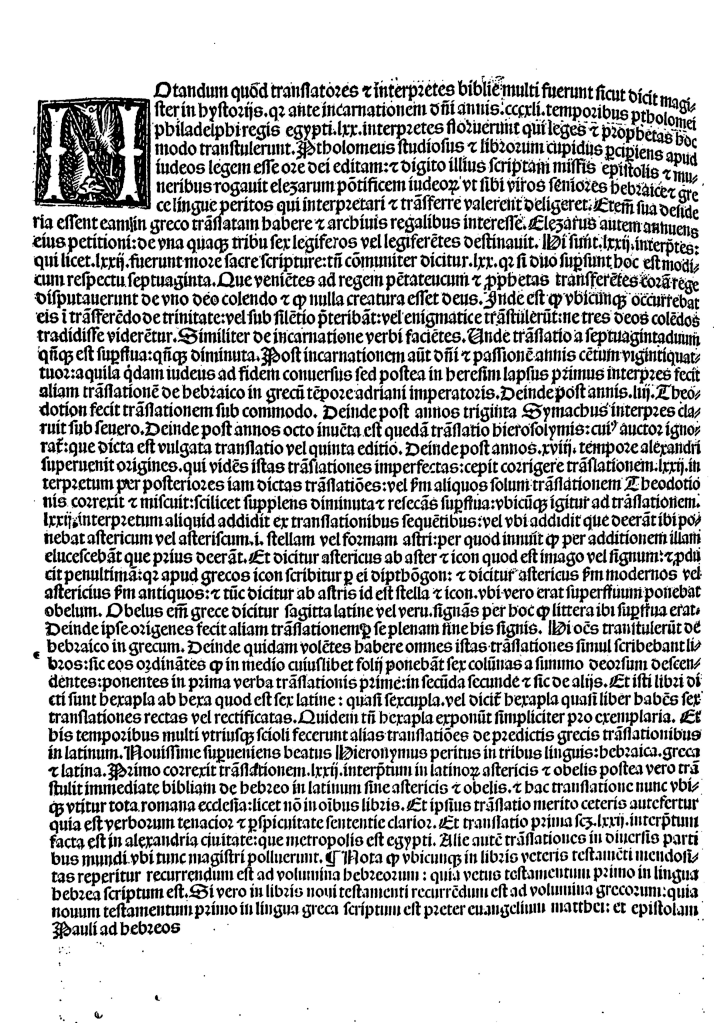
❧ Corrected Latin Text
- Notandum quod translatores et interpretes biblie multi fuerunt, sicut dicit magister in hystoriis. Quod ante incarnationem domini annis CCCXLI temporibus Ptholemei Philadelphi regis Egypti LXX interpretes floruerunt, qui leges et prophetas hoc modo transtulerunt.
- Ptholomeus, studiosus et librorum cupidus, percipiens apud Iudeos legem esse ore dei editam et digito illius scriptam, missis epistolis et muneribus, rogavit Eleazarum pontificem Iudeorum ut sibi viros seniores hebraice et grece lingue peritos, qui interpretari et transferre valerent, deligeret.
- Et enim sua desideria essent eam in graeco translatam habere et archivis regalibus interesse.
- Eleazar autem annuens eius petitioni, de una quaque tribu sex legiferos vel legiferentes destinavit.
- Hi sunt LXXII interpretes, qui licet LXXII fuerunt more sacre scripture, tamen communiter dicitur LXX; que si duo supersunt, hoc est modicum respectu septuaginta.
- Qui venientes ad regem, Pentateucum et prophetas transferentes, coram rege disputaverunt de uno deo colendo et quod nulla creatura esset deus.
- Inde est quod ubicunque occurrebat eis in transferendo de trinitate, vel sub silentio praeteribant, vel enigmatice transtulerunt, ne tres deos colendos tradidisse viderentur.
- Similiter de incarnatione verbi facientes. Unde translatio a septuaginta duum quaeque est superflua, quaeque diminuta.
- Post incarnationem autem domini et passionem annis centum vigintiquattor, Aquila quidam Iudeus ad fidem conversus, sed postea in heresim lapsus, primus interpres fecit aliam translationem de Hebraico in Grecum tempore Adriani imperatoris.
- Deinde post annis LIII, Theodotion fecit translationem sub Commodus. Deinde post annos triginta, Symachus interpres claruit sub Severo. Deinde post annos octo, inventa est quedam translatio Hierosolymis, cuius auctor ignotus; quae dicta est vulgata translatio vel quinta edition.
- Deinde post annos xviii tempore alexandri supervenit Origenes. Qui videns istas translationes imperfectas, cepit corrigere translationem lxxii interpretum per posteriores iam dictas translationes; vel aliquando solum translationem Theodotionis correxit et miscuit: scilicet supplens diminuta et resecans superstua.
- Ubi cumque igitur ad translationem lxxii interpretum aliquid addidit ex translationibus sequentibus; vel ubi addit quae deerant, ibi ponebat asteriscum vel asteriscum, id est, stellam vel formam astri: per quod innuit quod per additionem illam elucescebant quae prius deerant.
- et dicitur astericus ab aster et icon quod est imago vel signum; et perducit ad penultimam: quia apud Graecos icon scribitur per ei diphthongon; et dicitur astericus a quidam modernis vel astericus a quidam antiquis; et tunc dicitur ab astris, id est stella, et icon; ubi vero erat superfluum, ponebat obelum.
- Obelus enim Graece dicitur, sagitta Latine vel veru, signans per hoc quod littera ibi superflua erat. Deinde ipse Origenes fecit aliam translationem, quam se plenam sine duobus signis.
- Hi omnes transtulerunt de Hebraico in Graecum. Deinde quidam, volentes habere omnes istas translationes simul, scribebant libros: sic eos ordinantes quod in medio cuiuslibet folii ponebant sex columnas, a summo deorsum descendentes: ponentes in prima verba translationis primae, in secunda secundae, et sic de aliis.
- Et isti libri dicti sunt hexapla ab hexa, quod est sex latine: quasi sexcupla. Vel dicitur hexapla quasi liber habens sex translationes rectas vel rectificatas. Quidem tunc hexapla exponunt simpliciter pro exemplaria et in Latinum.
- Novissime superveniens beatus Hieronymus, peritus in tribus linguis: Hebraica, Graeca, et Latina. Primo correxit translationem LXXII interpretum in Latinum, astericis et obelis. Postea vero transtulit immediate bibliam de Hebraico in Latinum sine astericis et obelis. Et hac translatione nunc ubique utitur tota Romana Ecclesia, licet non in omnibus libris.
- Et ipsa translatio merito ceteris praefertur, quia est verborum tenacior et perspicuitate sententiae clarior. Et translatio prima, scilicet LXXII interpretum, facta est in Alexandria civitate, quae metropolis est Aegypti.
- Aliae autem translationes in diversis partibus mundi ubi tunc magistri polluerunt.
- Nota quod ubicunque in libris Veteris Testamenti mendacitas reperitur, recurrendum est ad volumina Hebraeorum; quia Vetus Testamentum primo in lingua Hebraea scriptum est.
- Si vero in libris Novi Testamenti, recurrendum est ad volumina Graecorum; quia Novum Testamentum primo in lingua Graeca scriptum est, praeter Evangelium Matthaei et Epistolam Pauli ad Hebraeos.
❧ English Translation
- It is worth noting that there were numerous translators and interpreters of the Bible, as chronicled by the learned historian. Specifically, 341 years prior to the Lord’s incarnation, under the reign of Ptolemy Philadelphus of Egypt, seventy scholars flourished, translating the laws and the prophets in a unique manner.
- Ptolemy, an avid scholar with a penchant for books, recognizing amongst the Jews a law voiced by God and penned by His divine hand, dispatched letters and gifts. He beseeched Eleazar, the Jewish high priest, to select for him elder men proficient in Hebrew and Greek, capable of adeptly interpreting and translating the sacred text.
- Indeed, his ardent wish was to possess its translation in Greek and for it to be enshrined in the royal archives.
- In response, Eleazar, heeding the king’s request, appointed six biblical scholars from every single tribe.
- These are the seventy-two translators, who were seventy-two according to tradition, but who are also commonly referred to as seventy. It is a small matter, if two are added, in comparison to seventy.
- When they approached the king and translated the Pentateuch and the prophets in his presence, they debated the principle of worshiping a single God and asserted that no creature could be considered divine.
- From this, it is clear that whenever they encountered a reference to the Trinity in their translation, they either subtly sidestepped it, or rendered it cryptically, to avoid any hint of endorsing the worship of three distinct gods.
- Similarly, when addressing the Incarnation of the Word, the Septuagint translation tends to be either over or understated.
- One hundred and twenty-four years after the Lord’s incarnation and passion, a Jew named Aquila converted to the faith. However, he later fell into heresy. During Emperor Hadrian’s reign, Aquila became the first to craft a new translation from Hebrew into Greek.
- Then, fifty-three years later, Theodotion crafted a translation during Commodus’ reign. Next, in another thirty years, the translator Symmachus rose to prominence under Severus. Then, eight years later, a separate translation appeared in Jerusalem, referred to as the common or fifth translation, of which the author remains unknown.
- Then, after another eighteen years, during the time of Alexander, Origen arrived. Seeing these imperfect translations, he began to correct the Septuagint translation using subsequent translations; or sometimes he only corrected and combined Theodotion’s translation, filling in what was lacking and cutting out what was excessive.
- So, wherever he added something to the translation of the Septuagint from the subsequent translations, or wherever he added something that was missing, he would place an asterisk or a star, that is, the form of a star: indicating that through this addition, what was previously missing became clear.
- The term astericus is derived from ‘aster’ and ‘icon,’ meaning an image or symbol. It shifts the stress to the penultimate syllable because, in Greek, the word ‘icon’ is spelled with the ‘ei’ diphthong. The term astericus is cited by some modern sources and by some ancient ones, and in this context, it’s referred to by the word astris, meaning star, and ‘icon.’ However, wherever there was something extraneous in the text, he would insert an obelus.
- The term ‘obelus’ is Greek, but in Latin, it’s called sagitta [arrow] or veru [skewer]. It indicates that there was an extraneous letter at that place. Later, Origen himself produced another translation, considering it complete without using either symbol.
- All these translated from Hebrew into Greek. Subsequently, some, wanting to have all these translations together, wrote books, arranging them in such a way that in the center of each page they placed six columns descending from top to bottom: placing in the first column the words of the first translation, in the second the words of the second, and so on for the others.
- These books are called the ‘Hexapla’, derived from ‘hexa’ meaning six in Latin, akin to the word ‘hexagon’. So ‘Hexapla’ is used to describe a book containing six direct or revised translations. Indeed, at that time the ‘Hexapla’ simply stood for the exemplars, and it was in Latin.
- Lastly, the blessed Jerome, skilled in three languages: Hebrew, Greek, and Latin, first corrected the translation of the Septuagint into Latin using asterisks and obelisks. However, he later directly translated the Bible from Hebrew into Latin without the use of asterisks and obelisks. And this translation is now universally used by the entire Roman Church, though not for all the books.
- Indeed, this translation rightly surpasses others because it adheres more closely to the words and is clearer in the lucidity of its meaning. The first translation, namely that of the Septuagint, was made in the city of Alexandria, which is a city in Egypt.
- Other translations were made in various parts of the world where teachers of that time had made their mark.
- Note that wherever inaccuracies are found in the books of the Old Testament, one should refer to the Hebrew scrolls — because the Old Testament was originally written in Hebrew.
- If, however, there are issues in the books of the New Testament, one should refer to the Greek scrolls — for the New Testament was primarily written in Greek, except for the Gospel of Matthew and Paul’s Letter to the Hebrews.

